Fresh Concrete Recycling
PROTEM PCRS 80/100/125
Fresh concrete recycling system
Managing the fresh concrete leftovers in the truck mixers and concrete pumps, as well as in the plant’s mixer, is a daily problem that ready-mix concrete industries have to cope with.
Beyond the environmental aspect and the obligations arising from legislation, an equally important issue is the economical one. Typical practices such as disposal of the residual concrete on the ground or in tanks and their management at a later time as dried concrete, among other negatives, are also economically unprofitable.
PROTEM offers you a complete and profitable solution to your problem and with absolute certainty that the cost of investment will sooner or later be amortized by the benefits of our solution.
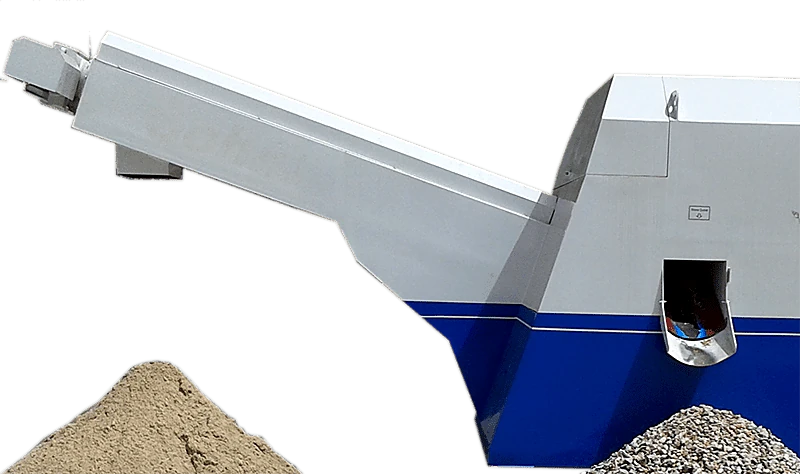
The heart of PROTEM’s concrete recycling system is the reclaimer that is washing and separating all the concrete residues from the vehicles and the plant’s mixer. At the exit of the reclaimer the inert materials are washed out and separated into two piles: sand 1-5 mm and gravel> 5 mm while the sludge water (cement and other fine components under 1mm) reach the settling pit. The water required for the reclaimer and the vehicles comes entirely from recycling.
ADVANTAGES
- 01Unlike other available systems that extract a single material, our system separates aggregates according to their size into two piles.
- 02The aggregates extracted by the system are sufficiently dry and can be transferred directly to the aggregate bunkers of the plant for use in production.
- 03Drivers empty the concrete residues in the receiving hopper of the system without having to pay attention to the feed rate (those with experience in other recycling systems understand how important that is).
- 04The reclaimer is a compact and very ergonomically designed structure, without complicated mechanisms and expensive spare or wear parts. It operates at very low power consumption while minimum maintenance is required.
SYSTEM BENEFITS
- 01Restriction of consumption and rational use of fresh water. The use of fresh water is limited to the production of concrete, while for all other uses, only recycled water is used.
- 02Saving of raw materials due to reuse of recycled aggregates in the production
- 03Effective implementation of eco-policy and compliance with the environmental legislation.
- 04Minimize waste of ready-mixed concrete as 85% of it is recycled while the remaining 15% is a powder of inactivated cement and filler. This material, even if it is not used in other applications (many studies are taking place worldwide), can be deposited in nature without negative impact on the environment.
- 05Requires minimum plot space for the installation.
- 06Simple set-up and fully automatic operation without the need of an operator.
- 07Secured & fast Return of Investment
AVAILABLE MODELS
PROTEM offers three recycling models, each with a different capacity, so you can choose what meets your real needs.
| Feature | PCRS – 80 Model | PCRS – 100 Model | PCRS – 125 Model |
|---|---|---|---|
| Recycling capacity | 8-10 m3/h | 12-14 m3/h | > 17 m3/h |
| Mixing Trucks Nr. | 1-10 | 10-30 | >30 |
| Reclaimer Dimensions | 4.8 x 1.4 x 2.2 m | 6.1x1.6x2.5 m | 6.9x1.8x2.8m |
| Reclaimer Weight | 3.400 Kg | 4.170kg | 5.270kg |
| Total Power* | 17 kW | 22 kW | 9.5 kW |
| Washing Hopper | 1 Vehicle, 3m Length | 2 Vehicles, 7m Length | 3 Vehicles, 10m Length |
- Including the submersible sewage Water pumps
UPGRADES
The system can be upgraded to support concrete pumps washing ability (for all models)
The pumps are washed in a separate depositing place which empties inside the reclaimer, without preventing the mixer trucks from being washed in parallel. The water required for cleaning the concrete pumps comes 100% out of recycling.
Did you know that...
The wastewaters of ready-mixed concrete plants are classified as severely dangerous by international organizations and the E.U. due to their alkalinity (very high pH). Therefore, when they are not properly managed and leak to the environment, they pollute the aquifer and through rainwater the pollution extends to the rivers, lakes and sea.
Photos
Open to new challenges
Connect with us
Do you prefer live communication? So do we!